
If you were sitting across from me and I had to explain, straight up, what the college process has felt like so far, I’d start with two numbers: time and money. People talk about college applications as a fall-of-senior-year thing, but for me, it’s been four years of my life crammed into forms, essays, deadlines, and panic sessions where I try to say a whole life in a couple hundred words. Every essay felt like a microscope on my existence, and every application felt like a financial investment I couldn’t ignore.
I’ve taken the ACT six times already, with two more scheduled. Each time, it’s a mix of dread and determination — early mornings at test centers, practice tests stacked like mini towers on my desk, timing drills, multiple essay rewrites, and a fair amount of caffeine. And that’s just the ACT. Applications? Each one is a tiny project: a form, a fee, an essay that somehow asks the same question in a slightly different way. The schools I’ve tackled so far include Belmont, Penn State’s undergrad/BS-MD program, UTK, UAB’s BS-MD program, Vanderbilt, Wayne State BS-MD, and MTSU BS-MD. That’s seven applications, seven sets of expectations, seven ways of squeezing your identity into a format that admissions officers can digest in 20 minutes or less.
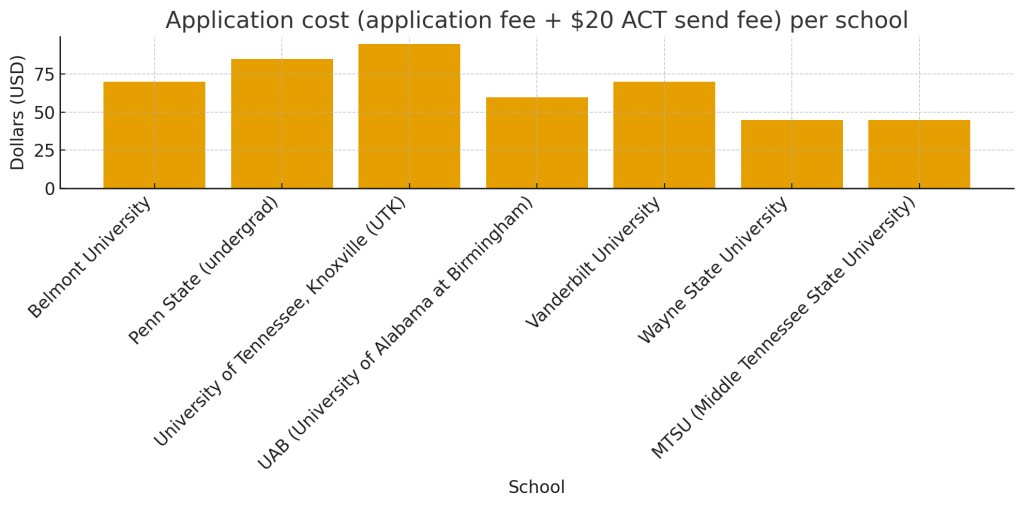
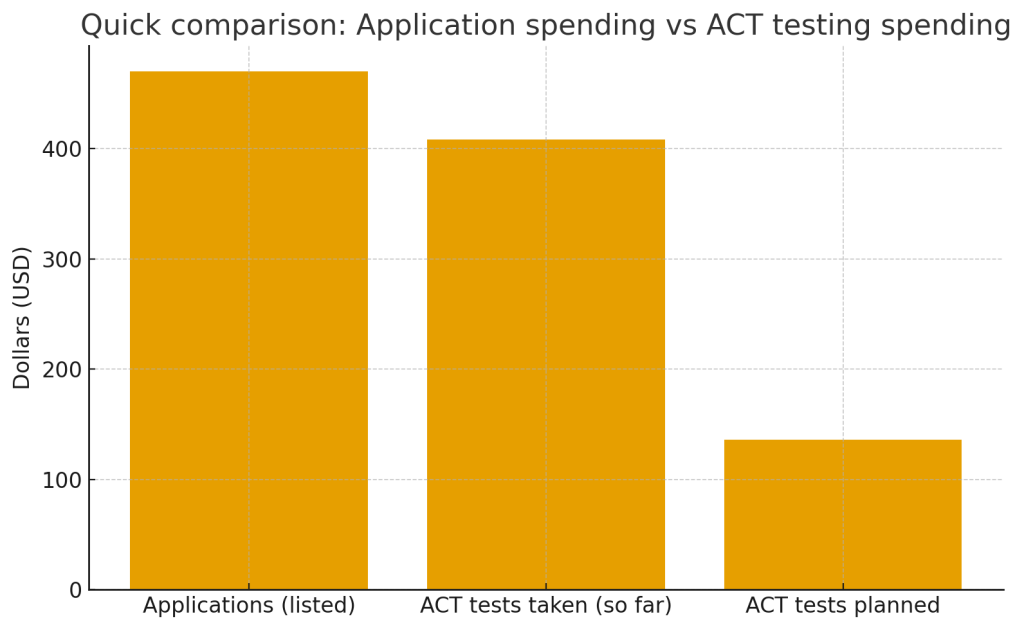
The money adds up fast. Every application has a fee, and sending the ACT scores adds another $20 each. The ACT itself costs $68 per test. The total for these seven schools plus the six ACTs I’ve already taken comes to around $878 — and I’ll cross $1,000 once I take the last two ACTs. That’s real money, for a lot of things that might not even guarantee me a single acceptance. And yet, like most applicants, I keep paying, because each test and application feels like a small hedge against rejection, a chance to keep my options alive.
The Essays — Where the Hours Go
I’ve probably spent close to 1,000 hours writing and revising essays across all these applications. That’s not an exaggeration. Sitting down to distill my entire high school life into 250 words is almost physically exhausting. Each program wants a slightly different version of me. My “honest self” is messy, contradictory, and loves stories that take three paragraphs to tell. The “admissions self” is concise, formatted, and strategically emotional.
I rewrote the same stories many times. One story about leading a podcast team became a leadership essay, then a community service essay, then a media essay, depending on the prompt. The story about coordinating a festival became an example of logistics, teamwork, or cultural impact depending on what the school wanted. It’s mentally draining, and eventually, you start editing your own memories to fit a word limit.
But here’s the thing — it’s also been valuable. The essays forced reflection. I had to explain why I care about medicine beyond “I like science.” I had to look at what I actually did over the past four years: organized a podcast team that grew from 15,000 to 500,000 views in a year while managing a 20-person team, coordinated a local festival with 50 volunteers and hundreds of guests, volunteered at a veterinary clinic drawing blood and assisting in procedures. Seeing how all these things connected made me appreciate my experiences in a way I hadn’t before. The essays became a mirror, showing me how my leadership, service, and media work actually formed a coherent story.
Me as an Applicant
Organized a podcast team — led 20 people, scaled listenership from ~15k to ~500k views in a year, managed bi-weekly episodes.
Coordinated a festival — led ~50 volunteers, presented to ~300 guests, secured funding and supplies so it was free to attend.
Volunteered at a veterinary clinic — drew blood, assisted on basic procedures, managed front desk operations.
Shadowed clinicians — primary care and optometry, learning patient care and communication.
Ran community projects — founded a public safety advocacy site, lobbied local officials successfully.
Built and maintained websites — four client sites with tens of thousands of visits in a year.
Wrestling captain — led over 50 team members, mentored younger athletes, drove regional success.
Medical service trip — supported care for underserved children, created bilingual outreach media.
These aren’t meant as bragging points — they’re what I had to translate into essays, short responses, and interviews. And honestly, these are also what kept me grounded. When the process felt pointless, these experiences reminded me of the real impact I’ve had.
The Worst Part — Pressure + The Math
There’s the obvious stress of waiting for decisions, but a bigger, more annoying thing is the math: hundreds of hours, hundreds of dollars, my final year carved up for applications that might only get me a handful of acceptances. I’ve applied to multiple BS-MD tracks and specialized programs with extremely low acceptance rates. Realistically, I might get into four or five of the ~17 programs I’ve targeted across everything. You do the work anyway, because options matter. But it’s heavy knowing so much effort could translate into only a few acceptances.
The Best Part — Reflection and the People
Despite the pressure, there’s a silver lining. The application process forced me to look back and see how my experiences connect. The podcast taught me how to manage a team and how to extract stories that resonate with people. The festival taught me fundraising, logistics, and cultural storytelling. Volunteering taught me humility and that small acts — keeping a clinic tidy, making a kid smile — matter as much as big projects.
And the people. Teachers who wrote letters, teammates who covered practice when I had meetings, volunteers showing up at 7 a.m. — those relationships are what I’ll remember more than emails that say “admitted” or “denied.” They’re also why I think leadership and service are bigger than bullet points on an application. The moments of connection stick with you.
Practical Tips I Learned the Hard Way
Start essays early — like, sophomore-junior-year early if you’re aiming for programs with essays at application time.
Keep a “story bank” — short anecdotes, numbers (hours, people involved, outcomes). Tailoring essays gets way easier.
Track costs — spreadsheets for applications, tests, sending fees. It keeps financial stress manageable.
Use fee waivers — both for tests and applications. Money shouldn’t stop you if you qualify for assistance.
Message to Parents
If you’re reading this as a parent, here’s the plain truth: the rules are different now, and the tools are different. It’s not unusual for your kid to know more about the current college application workflow than you. TikTok and Instagram aren’t just for trends — there are real admissions officers and professional coaches sharing concrete advice there. Don’t dismiss it just because it’s on social media. Ask for the source, check official pages, and trust them if it’s legitimate. The landscape has changed, and your support matters most when it’s informed, not nostalgic.
Money Breakdown — Short and Painful
| Item | Quantity | Cost per Unit | Total |
|---|---|---|---|
| ACT test | 6 | $68 | $408 |
| ACT send fee | 7 apps | $20 | $140 |
| Applications | Belmont, Penn State, UTK, UAB, Vanderbilt, Wayne State, MTSU | varies (see below) | $470 |
| Grand total so far | $878 | ||
| Projected total (with 2 more ACTs) | $1,014 |
Sources: Official ACT registration page, official application pages for each university.
Advice for Students
Keep the narrative in mind. Applications are messy reflections of luck and timing, not your worth.
Focus energy strategically. Tailor essays for schools that care about portfolios, leadership, or particular experiences.
Watch for fee waivers and free-application windows — many universities have them seasonally.
Don’t ignore the mental load. Build downtime into your schedule or you’ll burn out.
Closing — Where I’m At
Right now, I’m tired, kind of proud, and low-key terrified. I’ve spent hundreds of hours shaping essays, organizing projects, and juggling tests — and it’s all for applications that might only get me four or five acceptances. But I’ve learned how to tell my story, how to manage projects that make a difference, and how to navigate a system that really is expensive and stressful.
The experience has been humbling. I’ve learned the value of reflection, relationships, and strategy. I’ve learned that leadership and service aren’t just bullet points; they’re real experiences with real outcomes. And I’ve learned that college applications, as stressful as they are, are also a mirror — showing what you’ve done, what you care about, and who you want to be.
If I could tell my freshman self one thing, it’d be: start documenting early, pay attention to the small wins, and don’t underestimate the emotional weight of this journey. Every form, every essay, every dollar spent is part of a story that’s bigger than acceptance letters. And maybe that’s the biggest lesson of all: this process is not just about getting into college, it’s about seeing your life in a new way.